

Here is a question worth asking anyone on your property team right now: when does the rooftop exhaust fan turn off? If the answer is "never", or if nobody knows, this is for you. The U.S. Department of Energy has found that buildings are routinely overventilated by as much as six times their minimum required rates. In multifamily buildings with shared rooftop exhaust systems, that overventilation almost certainly does not appear anywhere in your building reports. It shows up instead as elevated HVAC runtime, utility bills that stay stubbornly high even after maintenance, and comfort complaints that keep coming back without a clear cause. For many mid-rise and high-rise buildings, the drain has been running for years without being named. You do not need a full airflow study to decide whether this deserves a closer look. Start with these three signs.
Before the signs: a quick explanation of the mechanism, because the cost is bigger than most people expect. In a building where one rooftop fan serves multiple floors through a common riser (bathroom exhaust, kitchen exhaust, dryer exhaust) that fan pulls conditioned air out of the building continuously. Every cubic foot of air it exhausts was heated, cooled, or dehumidified at the building's expense. When it leaves, replacement air comes in from outside. That outside air then must be conditioned too. Research published in Energy and Buildings found that air exchange accounts for approximately 36% of total space conditioning energy across residential buildings. The New York State Energy Research and Development Authority documented that multifamily buildings with excessive ventilation can spend over 20% of total energy on ventilation alone. The fan's own electricity consumption is real, but it is the smaller part of the problem. The larger cost is the HVAC system working continuously to replace and recondition air that did not need to leave in the first place. The fan is the valve. The HVAC system pays the bill.
Exhaust demand in a shared system changes constantly. Bathroom exhaust tends to peak in the morning and evening. Kitchen exhaust rises around meal times. Dryer exhaust clusters in the evening and on weekends. Overnight, demand across all three typically drops well below the daytime peak.
In most multifamily buildings, dryers are idle roughly 70% of the day. The chance that multiple dryers across different floors are running simultaneously runs under 2% of daily hours — fewer than 30 minutes. Yet a constant-speed fan treats a building with two dryers running the same as a building at full load.
That gap has a measurable energy cost. A fan running at full speed during off-peak hours is not 20% or 30% oversized for the demand — it may be running several times the required rate. The energy waste scales accordingly.
The simplest field check: note the fan sound near the roof access, parking lot, or courtyard at 2 AM, and again at 8 AM. If the fan sounds the same at both times, the system is exhausting conditioned air in the middle of the night as if every bathroom, kitchen, and dryer in the building is active.
A shared exhaust fan must maintain the right negative pressure across a vertical duct network serving multiple units. When fan speed is fixed, the pressure balance shifts as different fixtures come in and out of use throughout the day.
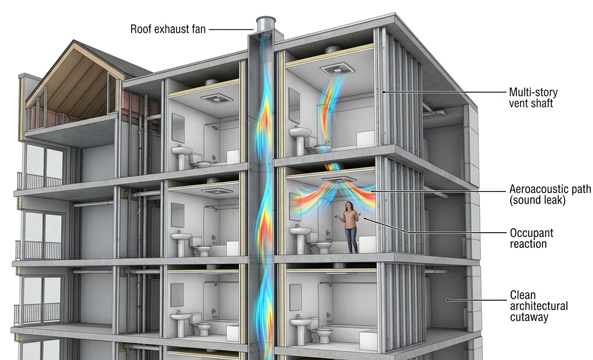
Building Science Corporation research on multifamily central ventilation systems has documented exactly this pattern: constant-speed central exhaust systems typically overventilate some portions of the building while simultaneously underventilating others. During low-demand periods, the fan may pull harder than the active branches need — producing noise, drafts, or backdrafting at individual grilles. When demand spikes elsewhere on the riser, airflow shifts, and branches that were working fine may suddenly underperform. The fan is still running at full speed. The problem is that it cannot modulate.Pull three to six months of work orders and group them by riser, floor range, and appliance type. If the same areas appear repeatedly — especially if complaints alternate between "too much draft" and "not enough exhaust" at different times — the fan's fixed-speed operation is likely the common thread.
This sign requires a specific condition to be useful: you have already looked at the building envelope and addressed the obvious maintenance items — and utility costs are still elevated, or comfort complaints persist.That pattern is the fingerprint of continuous exhaust-driven conditioned air loss. The HVAC system is not running long because of a failed component or poor insulation. It is running long because it is continuously replacing air that the exhaust system is continuously removing. Until the exhaust system changes its behavior, the HVAC system cannot catch up. Building Science Corporation research in multifamily buildings found that ventilation control alone accounted for roughly 25% of total heating energy — a cost embedded invisibly in HVAC runtime rather than attributed to the exhaust system driving it. That is why this problem persists: it never appears on its own line in a utility bill or building report, and no individual repair closes the gap until the exhaust behavior itself changes.
The most direct way to illustrate the scale of the problem is a documented example. A Maryland condominium with 14 exhaust shafts serving 126 kitchen hoods across nine stories retrofitted from constant-speed to demand-controlled exhaust and recorded $38,584 in annual savings. The project paid back in 22 months and delivered a 172% five-year ROI.
That building is not an outlier in terms of profile — it is a representative mid-rise multifamily building with a shared riser configuration common across the country. What made the savings possible was not a unique set of circumstances. It was stopping a fan from running at full speed around the clock in a building where full-speed operation was only warranted for a fraction of the day.
Climate, utility rates, building size, and riser configuration will all affect the outcome in any specific building. But the direction is consistent: the cost of continuous operation accumulates year over year, and it does not appear on any report until someone goes looking for it.
Replacing an aging rooftop fan with a new constant-speed unit addresses noise, reliability, and age. It does not change the operating pattern. The new fan exhausts conditioned air at full speed around the clock, same as the old one. The HVAC system keeps paying the same replacement-air penalty.
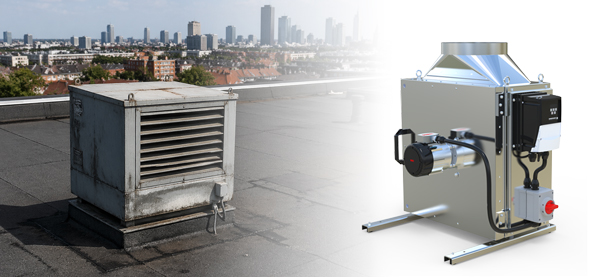
ENERVEX MBESr is designed for this retrofit in mid- and high-rise buildings with shared kitchen, bathroom, and dryer exhaust risers. It replaces the existing rooftop fan without requiring a full ductwork redesign — the riser stays, the constant-speed behavior goes.
The assessment ENERVEX offers produces a specific estimate: what continuous exhaust operation is currently adding to your annual operating costs, calculated against your building's riser configuration, local utility rates, and climate. That number is what decides whether this is worth acting on. If no one on your team knows when the fan slows down — that is the right place to start.
Contact ENERVEX to get your building's number.