


An office building with its own central boiler plant is spending significant money every heating season. Most owners can point to a lighting retrofit or a chiller upgrade before they can say what share of that fuel is actually reaching a radiator or an air handler instead of leaving through the flue. That gap, fuel burned but never delivered as useful heat, is one of the largest and least-examined line items sitting inside a central plant, precisely because it's invisible on a utility bill that only shows the total.
It's also one of the more straightforward things to fix, and the fix doesn't require touching the boiler itself.
Natural gas is the dominant fuel behind that load, accounting for roughly three-quarters of the energy commercial buildings use for space heating nationally. More to the point for a plant's economics, buildings in cold and very cold climate zones run their heat close to continuously for months rather than cycling on and off, with 62 percent reporting they heat essentially their entire floorspace through the season. That's the exact run-time profile that makes flue gas heat recovery worth the capital: the pay-back math depends on annual operating hours, and a central plant running hard for five or six months a year accumulates exactly the hours an economizer needs to earn its cost back.
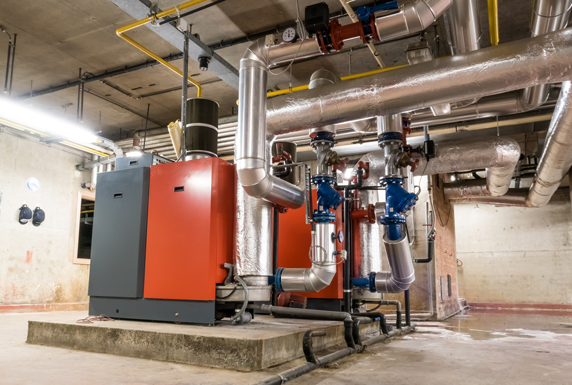
Every one of those boilers is losing some of that fuel's value up the stack. Combustion leaves some heat behind in the flue gas, and in a boiler that hasn't been fitted with heat recovery, that gas is leaving the building at several hundred degrees, carrying paid for heat straight into the outside air. It's not a malfunction. It's how a standard boiler plant is built to operate, and it's exactly the kind of cost that doesn't show up anywhere except a bigger gas bill than the building's actual heating need should produce.
This isn't a new or exotic technology, though not every version of it performs the same. A flue gas heat exchanger sits in the exhaust path of an existing boiler and transfers heat from the flue gas into incoming water before that gas leaves the stack. The U.S. Department of Energy's steam efficiency guidance describes the underlying physics plainly: boiler efficiency improves by roughly 1 percent for every 40 degrees Fahrenheit the exhaust temperature is reduced, and DOE notes the equipment makes the most sense on boilers over 100 horsepower running significant annual hours. The equipment this guidance describes, older tube-style economizers, typically capture only 3 to 4 percent of that potential in practice, limited by heat transfer surface area and prone to their own failure modes, steaming, corrosion, cracked welds, under real operating conditions.
The math is worth showing at real scale. For a typical two-boiler hydronic plant, two 12 million Btu/hr watertube boilers at 82 percent efficiency, a common configuration in a large office or institutional building, ENERVEX's own modeling puts a VHX heat exchanger retrofit at roughly $40,000 a year in gas savings, for an installed cost under $350,000 and a 4.2-year simple payback. It is not instant, but it buys condensing-boiler-level efficiency and emissions reduction without replacing the boilers: actually swapping in new condensing boilers to hit the same efficiency would run hundreds of thousands of dollars more for a payback beyond 30 years on that spend.
The pressure on fossil-fuel-fired central plants is building on top of the fuel cost itself. Building performance standards that cap carbon emissions per square foot have moved well past a handful of early-adopter cities: as of 2026, more than 45 states, cities, and counties across the country have adopted benchmarking or performance-standard policies of some kind, and the list keeps growing every year. New York's Local Law 97 is the sharpest example of where this leads: it applies to buildings over 25,000 square feet, covers roughly 60 percent of the city's building area, and 57 percent of covered properties are already emitting above their 2030 targets, with caps ratcheting down further after that.
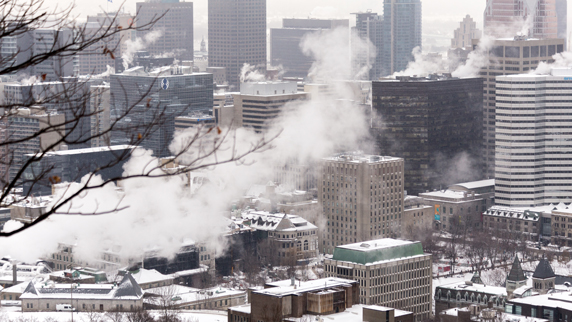
A building doesn't have to be in a city with a law this strict yet for the direction to matter to capital planning, and for an office building specifically, that planning usually runs through an asset manager or ownership group answering to lenders and investors who now expect emissions intensity on the reporting sheet alongside net operating income. Reducing how much fuel a boiler plant burns per unit of useful heat is one of the few central plant upgrades that pays for itself in fuel savings alone while also moving that number in the right direction, without requiring a full electrification rebuild before the capital is available for one.
Not every plant is worth this conversation, and it's worth being specific about which ones are. The clearest signals: boilers rated above 100 horsepower, a heating season long enough to rack up significant annual run hours, and stack temperatures still running several hundred degrees above ambient, which is the norm for a plant that has never had an economizer added. Older, non-condensing boilers tend to have the most to gain, simply because more usable heat is still leaving through the flue in the first place.
The other signal worth watching for is timing. A plant that's already scheduled for venting work, a code-driven upgrade, or a boiler replacement is the easiest and cheapest point to add heat recovery, because the flue path is already being opened up and engineered. Adding in heat recovery technology at that point costs a fraction of what the same equipment would cost as a standalone retrofit later, once the plant is closed back up.
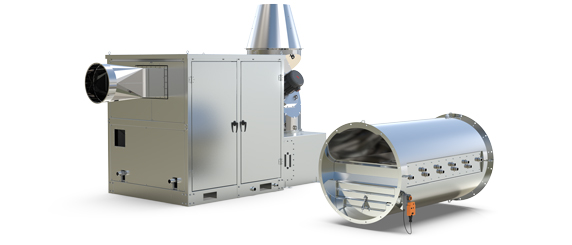
ENERVEX's PowerVex line of flue gas heat exchangers, including the VHX for inline installation on a single or multiple appliances and the IHX turnkey rooftop-mounted configuration, is built for exactly this application: factory-prefabricated, UL-listed equipment that recovers heat from an existing boiler's exhaust rather than requiring the plant to be rebuilt. Paired with PowerStack venting and modulating draft control, a central plant retrofit becomes one engineered system with single-source responsibility, instead of a mechanical draft contractor and a heat recovery vendor working from two different scopes.

This isn't a theoretical mechanism. Both applications show the technology performs. At Montreal's Olympic Stadium complex, a large public assembly facility running its own central boiler plant, ENERVEX installed a VHX heat recovery system with mechanical draft controls as part of a broader energy retrofit: boiler efficiency climbed to 89 percent, the system recovered roughly 4,300 MBH from a 45,000 MBH primary boiler, and the heat recovery installation paid for itself in under two years. The full retrofit cut the facility's energy bills by $1.55 million and won first place in the existing public assembly category of the 2019 ASHRAE Technology Awards.
A hospital boiler plant retrofitted with the same VHX-style economizer saw efficiency climb from 84 to 90 percent, recovering up to 7.4 million Btu per hour. Both are large buildings running a central plant hard, for long hours, on the same fuel and the same combustion physics as an office building’s boiler room. The technology performs, with real, measured numbers rather than projections.
A central boiler plant is one of the largest, least-examined cost centers in an office building's operating budget, and the fix for the fuel it's currently venting into the sky is neither speculative nor especially complex. It's engineering ENERVEX already does. For a building with a central plant that fits the profile above, especially one with venting work already on the capital plan, the next step is an ENERVEX engineering assessment: stack temperature, boiler run hours, and feasibility evaluated together, not a full capital rebuild. Schedule your assessment now to see understand your payback.