

Every rooftop exhaust fan has a service life, and every building reaches the end of it. When the fan serving a building's shared bathroom, kitchen, and dryer risers finally fails - bearings, motor, corrosion, age - the replacement is rarely treated as a decision.It is treated as a repair. Pull the old constant-speed unit, set a new constant-speed unit in its place, get the roof closed before the next storm. The whole thing is often settled in an afternoon, frequently under the time pressure of a fan that has already quit.
That decision commits the building to its exhaust operating cost for the next fifteen to twenty years. It is one of the larger financial decisions a property team will make in that window, and it almost never gets treated like one.
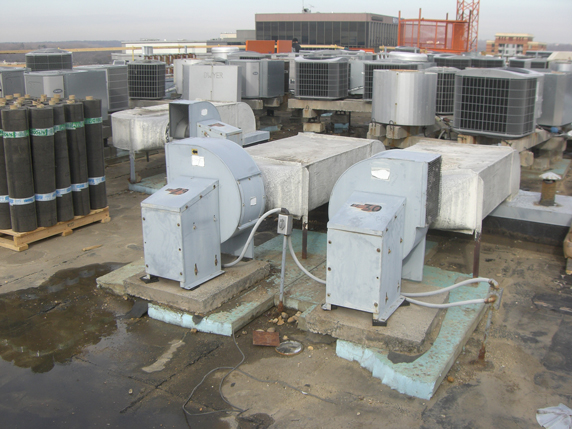
A rooftop fan replacement has three costs. Two of them appear on the invoice. The third does not, and it is the largest.
The first is the unit. A few horsepower of fan motor is a modest line item, and its own electricity runs somewhere between $1,000 and $3,000 a year to operate.
The second is access. Getting a crane to the roof, rigging the old unit down and the new one up, the roof penetration work, the permits and scheduling, the labor, and the resident-facing disruption of taking shared exhaust offline for the swap. On most projects this is the expensive part - far more than the fan itself. It is also largely fixed: the crane and the labor cost roughly the same whether the unit going up is constant-speed or modulating.
The third is the operating pattern the new fan locks in. A shared rooftop fan runs continuously, pulling conditioned air out of the building around the clock. Every cubic foot it exhausts was heated, cooled, or dehumidified at the building's expense, and every cubic foot is replaced by outside air the HVAC system then must condition from scratch. The fan's own electricity is the small part. The conditioning penalty it drives is roughly four times larger - on the order of 80% of what the system actually costs the building. That air-exchange loss is well documented at the building scale: ENERGY STAR attributes between 25% and 40% of a typical building's heating-and-cooling energy to air leakage and ventilation. None of it shows up on a single line item, and a new constant-speed fan inherits all of it.
Replacing an aging constant-speed unit with a new constant-speed unit solves the problems you can hear and see: the noise, the unreliability, the age. It changes nothing about behavior. The new fan exhausts conditioned air at full speed at 2 AM exactly as it does at 8 AM, in a building where overnight demand across every bathroom, kitchen, and dryer has dropped far below the daytime peak. Dryers alone sit idle roughly 70% of the day; the odds of several running at once are under 2% of daily hours. The fan cannot tell the difference. It pulls full load regardless, and the HVAC system pays to replace what it removes.
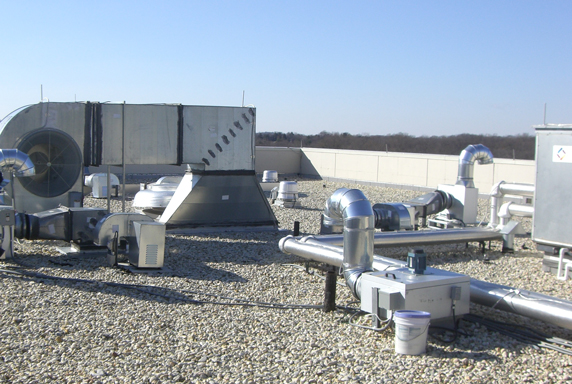
Building Science Corporation's study of multifamily ventilation retrofits documented the pattern directly: constant-speed central exhaust overventilates parts of a building while underventilating others, and ventilation control alone accounted for roughly a quarter of total heating energy in the buildings studied.
So the like-for-like replacement spends the entire access budget - the crane, the labor, the shutdown - and leaves the single largest cost exactly where it was.
Here is what makes the replacement moment different from any other: the expensive part is already being spent. The crane is coming. The unit is coming off the roof. The disruption is happening. The incremental cost of installing a system that modulates based on demand, instead of one that runs continuously, is small set against the access cost you are paying no matter which unit goes up.
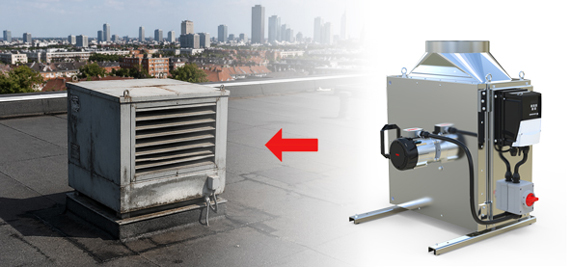
The ENERVEX MBESr (Modulating Retrofit Building Exhaust System) is built for exactly this swap. It replaces the existing rooftop fan without a full ductwork redesign - the riser stays in place, and only the constant-speed behavior goes. It fits inside the footprint of the replacement you were already going to do, which means the hard cost is already sunk and the upgrade rides on top of it.
A Maryland condominium made this change across fourteen exhaust shafts serving 126 kitchen hoods over nine stories. It recorded $38,584 in annual savings, paid back the difference in 22 months, and delivered a 172% five-year ROI. That payback is measured against the cost of the upgrade itself, and it lands faster still when the access spend underneath it is already in the budget. The building was not unusual. A representative mid-rise on a shared riser, common across the country. What changed was simply that the fan stopped running at full speed in a building that needed full speed for only a fraction of the day.
Decline the upgrade at replacement and the next chance to make it is the next failure, a full operating cycle of the penalty later. ASHRAE's equipment service-life data puts a roof-mounted ventilating fan's median life at about twenty years. That is the real cost of the default: not the price of the constant-speed unit, but the fifteen-to-twenty-year commitment it quietly signs on the building's behalf.
Which is why the decision is worth making before the fan fails, not after. A failed fan forces the default; there is no time to evaluate anything when shared exhaust is down and residents are calling. The better moment is the capital plan. A rooftop exhaust fan nearing the end of its life belongs in a reserve study the same way a roof or an elevator does as a known, scheduled expense with a decision attached, not a surprise the building absorbs at full price under pressure. If the rooftop fan is aging, or already sitting on that plan, the modulating option is worth exploring now, while there is still room to choose.

The ENERVEX MDVS Savings & Payback Calculator estimates what the choice is worth for a specific building. Enter the stories, shafts, and climate, and it returns an estimated annual loss, payback period, and fifteen-year lifecycle comparison. It takes about two minutes. It is a far better time to run the numbers than the morning the fan quits.